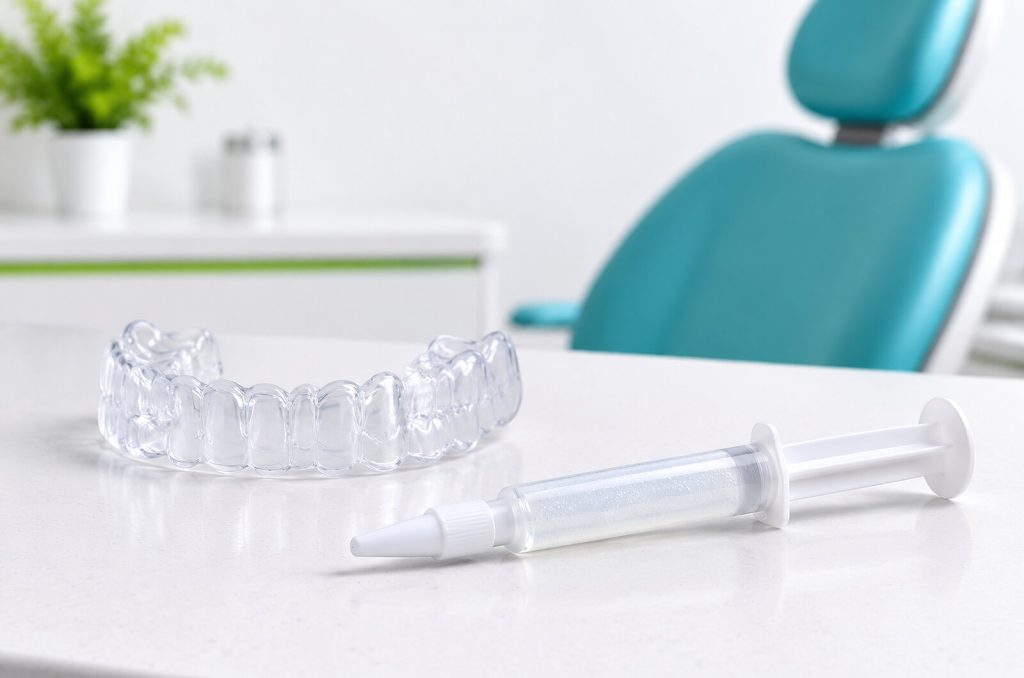
AI-generated illustration of whitening equipment; not the clinic, a specific product or a treatment result.
In-chair whitening is carried out at the dental clinic. Take-home whitening uses gel in custom-fitted trays at home. Both aim to lighten natural tooth enamel, but neither will whiten crowns, veneers or fillings, and some types of discolouration do not respond. A dental assessment of the cause of your staining comes before choosing either option.
If you are weighing up the two, start with what you have noticed rather than trying to pick a treatment online. Is it a general colour change, one tooth that looks different, or a mismatch around existing dental work? Bring those questions to your appointment.
At Ashburton Dental Centre in Gosnells, we offer in-chair teeth whitening and take-home whitening kits. Our take-home service uses trays made to fit your teeth. The choice needs to follow an assessment, not simply a preference for the fastest appointment.
Summary of the Content:
- In-chair treatment takes place in the clinic; take-home treatment uses a custom-fit tray at home.
- Your teeth and gums need to be checked, and dental disease treated, before cosmetic treatment.
- Fillings, crowns and veneers do not lighten with whitening gel.
- Tooth sensitivity and gum irritation are recognised risks.
- Ask about the cause of the discolouration, likely limitations, costs and the instructions for your own treatment.
What is different about in-chair and take-home whitening?
The main practical difference is where the gel is applied and how treatment fits into your day. With in-chair whitening, the gel is applied to the teeth in the dental clinic. With take-home whitening, you put the gel into a custom-fit tray and wear it at home according to the treatment instructions.
Better Health Channel describes clinic treatment as an appointment using a higher-concentration gel, while its home-treatment description involves repeated tray use. Those are general descriptions, not a timetable for your mouth. Ask the dentist how long your appointment or home course would involve.
For the decision itself, think about the practical commitment: would you prefer treatment at the practice, or can you make room for the instructed tray routine at home? Discuss that preference alongside the examination findings, rather than using convenience as the only deciding factor.
Does the type of staining change the decision?
Yes. Some types of discolouration do not whiten, so the cause needs to be assessed first. Choosing clinic treatment instead of trays does not remove the need to understand what is causing the colour change.
There is also a separate procedure called internal whitening for teeth that have discoloured after root canal treatment. It involves placing whitening material inside the tooth in the dental clinic. That is different from applying gel to the outside of the teeth.
If one tooth looks different, mention it specifically. Useful questions are: “What is causing this colour?”, “Is this the same issue as the staining on my other teeth?” and “Which options would you discuss for this finding?” You do not have to diagnose the stain yourself.
What if I have crowns, veneers or tooth-coloured fillings?
Whitening gel does not change the colour of crowns, veneers or fillings. Your natural teeth and existing dental work therefore need to be considered together before whitening. Our in-chair whitening information specifically advises discussing restorations and dark stains with the dentist before proceeding.
Point out any dental work that concerns you, especially where your question is about matching colours. Ask what would stay the same, what might change and what the limitations would mean for the appearance you have in mind. Do not assume that choosing a different whitening method will change the restoration itself.
Can sensitivity or gum problems mean whitening should wait?
They can affect whether whitening is appropriate. Our take-home information advises that whitening is not suitable for everyone and that persistent tooth or gum sensitivity needs assessment. Better Health Channel recommends a whole-mouth check and treating dental disease before cosmetic procedures.
Whitening commonly causes temporary tooth sensitivity. Gel that overflows onto the gums can cause irritation; our in-chair information also describes the risk of chemical burns when bleaching agents contact soft tissues. Professional supervision does not make these risks disappear.
Tell the dentist about existing sensitivity, soreness or other symptoms before starting. Ask how possible side effects will be managed and what should prompt you to contact the practice. If you have already started treatment and develop a concern, contact the dental team for advice rather than guessing how to adjust the treatment.
Our article about gum disease treatment and deep cleaning covers a different question: what gum treatment and follow-up involve. It is useful background if gum health, rather than colour, is your immediate concern.
What instructions should I have before taking a kit home?
Our take-home whitening service involves impressions to make custom trays. Before leaving, ask the team to explain your own product and plan. A general article cannot tell you the correct amount of gel or tray-wearing schedule for that plan.
- How much gel should I put in each tray?
- How long and how often should I wear the trays?
- When should I stop, and when will we check how things are going?
- What should I do if the trays rub, the gums feel sore or my teeth become sensitive?
- Who should I contact if an instruction is unclear?
Ask for the instructions in a form you can refer to at home. It is reasonable to ask the team to explain them again if you leave unsure what to do.
Do I need whitening, and what else should I consider?
You can choose not to have cosmetic treatment. If you do want to explore a change, the starting point is a healthy mouth, an explanation of the cause and a discussion of the available options and their risks. Better Health Channel advises discussing the expected result, complications, time and costs with your dentist.
Whitening does not keep teeth the same colour indefinitely. Better Health Channel notes that smoking and strongly coloured food and drinks can affect how long the change lasts, and that ongoing cleaning matters. Ask what maintenance would involve for you; do not assume repeated whitening is automatically needed.
Before agreeing to either route, ask for the costs and what is included. You can also ask whether your concern calls for whitening at all, whether another approach should be discussed, or whether no cosmetic treatment is the right choice for you.
Discuss whitening at Ashburton Dental Centre
You can arrange a dental check-up in Gosnells to discuss what you have noticed and ask whether whitening is appropriate. Bring your questions about sensitivity, existing dental work and the time you can realistically set aside for treatment.
Call (08) 9490 8777 or use our contact and booking page. Ashburton Dental Centre is at 9/62 Ashburton Drive, Gosnells, WA 6110.
By Dr Kav Bhinder (Dentist), Ashburton Dental Centre.
Sources
Sources checked 10 November 2026. This is general information for adults, not a diagnosis, an individual treatment plan or instructions for using a whitening product. Suitability, risks and alternatives need to be discussed with your dentist.
- Better Health Channel, Victorian Department of Health: Cosmetic dentistry and teeth whitening (reviewed 12 December 2025): assessment, whitening methods, limitations and risks.
- Ashburton Dental Centre: in-chair whitening, take-home whitening kits, dental check-ups, Dr Kav Bhinder’s profile and contact information.
Reference: www.betterhealth.vic.gov.au. The explanations and appointment questions are original writing; no source artwork or patient-education framework is reproduced.
The featured image is an AI-generated illustration, not a photograph of our clinic, staff, a particular product or a patient result.